- Home
- What we document
- Interior repairs
Interior repairs
Short answer
Interior walls and ceilings are usually gypsum board on framing, with taped and finished joints, primer and paint, and insulation behind. We document related interior repairs from the same loss, with project costs.
For roofing and exterior contractors.
Free estimate checkThe descriptions below follow the Gypsum Association and other public guidance listed under Sources.
How interior walls and ceilings are built
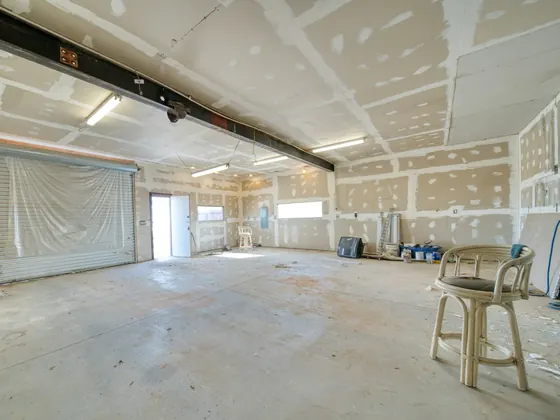
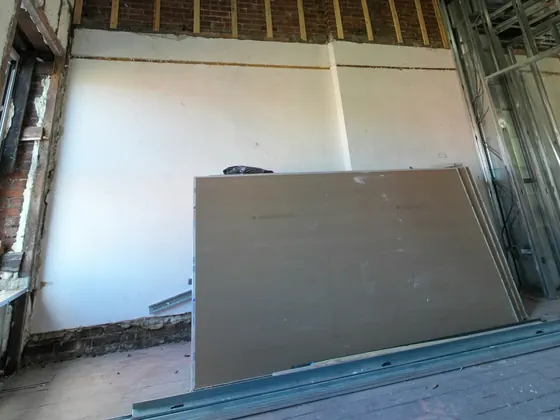
- Gypsum boardPanels with a core of gypsum, faced with paper, fastened to the framing. Ceilings go up first, then walls, and every end and edge lands on framing or other solid backing.
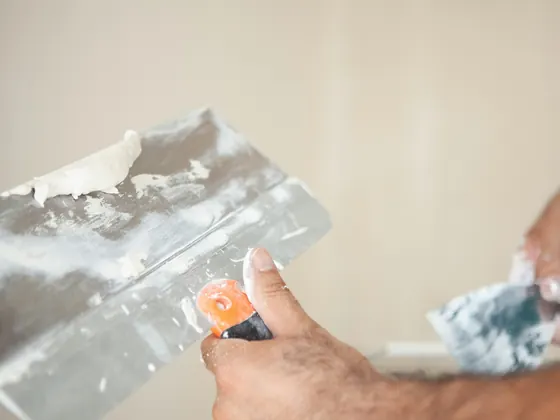
- JointsPaper tape is bedded in joint compound and covered with coats feathered progressively wider; fastener heads get several coats.
- Specialty boardsType X board, used in tested fire-rated assemblies; moisture-resistant board; and glass-mat or fiber-reinforced panels used as tile backers.
- InsulationBatts and rolls sized to the framing, loose fill blown into attics and cavities, spray foam and rigid boards. R-value measures resistance to heat flow.
Levels of finish
The Gypsum Association's GA-214 defines levels of finish from 0 to 5, from no taping at Level 0 to a thin skim coat over the whole surface at Level 5.
Primer and paint
Primer is the first coat over gypsum board; it evens out the surface between joint compound and face paper before the finish coats.
What we document here
- Related interior repairs from the same loss
- Project costs — overhead and profit, permits, disposal
Your package comes as an Xactimate® estimate.
We document only what is really there: every item traces to the property's documented condition and to a stated, checkable basis.
See every category we document and the sample package.
Our standard terms
Easy to start. Easy to leave.
- Pay after the job startsWe wait for your job: each invoice is due 15 days after work starts (or after the invoice, if later) and never later than 90 days after the invoice.
- Nothing upfrontNo deposit, no setup fee, no monthly fee. Homeowners never pay us.
- No exclusivity, no minimumsWork with anyone you like on other jobs. Send us only the files you choose, as many or as few as you like.
- Lose the job, owe nothingIf another contractor gets the job before work starts, and neither you nor a related business does the work, you owe us nothing on that file.
- Change your mind for freeClose a file's work order by email before we send you the first package, and you owe nothing on it.
- Fast, free estimate checksOne before you sign. After you sign, every insurer estimate you send us gets one.
- Leave any timeEnd the agreement by email, with no penalty. Work orders already open run to the end.
- Your customer stays yoursYou stay the contractor of record and your customer's contact.
Questions
Who pays you?
Nothing upfront. You — the contractor — pay us, on terms set out in your agreement. Homeowners never pay us.
When do we pay?
After the job starts. Each invoice is due 15 days after work starts (or after the invoice, if later) and never later than 90 days after the invoice, unless you lose the job to another contractor before work starts. Just email us the day work starts: materials delivered or tear-off begun.
What if we lose the job?
You owe us nothing on that file if another contractor gets the job before work starts and neither you nor a related business does the work. Just let us know and send us written confirmation.
What do we sign?
One master agreement, then a short work order for each file, signed electronically.
What format does the package come in?
Your package comes as an Xactimate® estimate.
Sources
Checked November 2026.
- Gypsum Association, Recommended Levels of Gypsum Board Finish (GA-214-10). Accessed November 2026.
- Gypsum Association, Application and Finishing of Gypsum Panel Products (GA-216-2010). Accessed November 2026.
- Gypsum Association, Frequently Asked Questions (FAQs). Accessed November 2026.
- Gypsum Association, Understanding the Differences Between Type X and Type C Gypsum Boards. Accessed November 2026.
- Drywall Finishing Council, Inc. (DWFC), Recommended Paint Systems Applied Over Gypsum Board, Glass Mat and Fiber-Reinforced Gypsum Panels (revised Feb. 22, 2018). Accessed November 2026.
- U.S. Department of Energy / Oak Ridge National Laboratory, Which Kind of Insulation is Best? (DOE Insulation Fact Sheet). Accessed November 2026.